CISC Launches New Steel Design Series

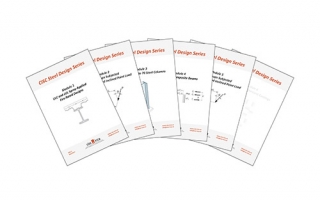
As part of a continuing effort to provide current and practical information for engineers, architects, designers, educators, fabricators and others interested in the use of steel in construction, the CISC recently launched a new series of concise steel design modules. Each module of the Steel Design Series (SDS) focuses on a steel design topic. The SDS [...]

2017-09-01T12:03:16-04:00June 28th, 2017|Tags: |

Structural Steel Pocket Data – 2017 Edition

The newly published 2017 edition of Structural Steel Pocket Data contains the main section dimensions (d, b, t, w) of structural sections listed in the current Handbook of Steel Construction, 11th edition. Intended for outdoor use by fabricators, erectors, designers, estimators and detailers, the booklet is printed on water-resistant and tear-resistant paper. The contents are as [...]

2021-08-31T11:04:34-04:00June 26th, 2017|Tags: |

Shear Stud Detailing

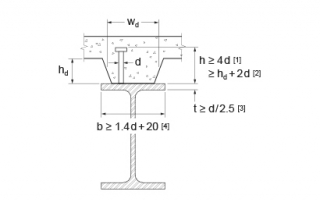
CSA S16-14 requirements for shear stud detailing aim mainly at ensuring that the studs will reach their design capacity as the composite member reaches its ultimate load. The accompanying figure shows a steel deck rib of average width, wd, and height, hd, supported on a girder with the deck ribs parallel to the girder. The headed [...]

2017-05-31T15:17:00-04:00May 31st, 2017|Tags: |

Advantages of Composite Truss Construction

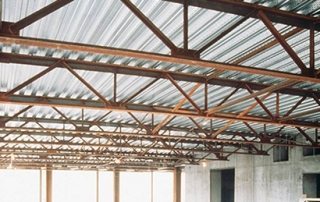
A composite truss consists of a steel truss fabricated from rolled sections, such as HSS, angles and WT, and a concrete slab atop the steel truss. Composite action between steel and concrete is achieved through the addition of headed shear stud connectors. The shear studs are field-welded through the sheet steel deck to the steel top [...]

2017-08-01T16:21:29-04:00April 20th, 2017|Tags: , |

The RCSC Specification

The Research Council on Structural Connections (RCSC) Specification for Structural Joints Using High-Strength Bolts provides state-of-the-art criteria for design and installation of ASTM high-strength bolts and assemblies. These recommendations become mandatory if and when the local code adopts them. In Canada, structural design and inspection of bolted joints and installation of high-strength bolts should comply with [...]

2017-04-17T15:19:11-04:00March 31st, 2017|Tags: , , , |

W-Shape Availability in the New Handbook

One of the most prominent features in the Handbook of Steel Construction, 11th edition, is the addition of availability data for wide-flange or W-shape sections. In Parts 4, 5 and 6, W-shapes that are commonly used and readily available are highlighted by the colour yellow, as shown on the accompanying figure. The design tables in which [...]

2017-04-21T14:40:17-04:00March 15th, 2017|Tags: , , |

Welded Double Angle Beam Connection

For common knife‑edge simple beam shear connection as shown in the figure below, it appears that the shear resistance can be improved by welding across the top edge of the angles. However, beam shear connections must exhibit sufficient end rotation to allow the attainment of bending capacity of a simply supported beam, for example. Therefore, welding [...]

2017-04-21T14:40:26-04:00March 7th, 2017|Tags: , |

Bolted Connections for Seismic Applications

Bolted connections, used in seismic‑force‑resisting systems (SFRS) for which the seismic design loads are based on a ductility‑related force modification factor, Rd, greater than 1.5, must satisfy Clause 27.1.6 of S16‑14 as well as other pertinent requirements that apply to bolted connections.   In accordance with Clause 27.1.6, these bolted connections shall:   (a) have pretensioned [...]

2017-04-03T12:58:32-04:00February 23rd, 2017|Tags: , , |

A Common Rehabilitation Solution for An Outdated Detail

The bolted detail shown in Figure 1 below is a popular detail in bridge retrofitting. The CSA Standard S6, Canadian Highway Bridge Design Code, requires that cross-frame connection plates be connected to both flanges of bridge girders. In this detail, the stiffener also serves as a cross-frame connection plate. Both distortion-induced fatigue (resulting from secondary stresses [...]

2017-04-03T12:58:23-04:00February 10th, 2017|Tags: , |
Go to Top