Torsional Section Properties of Steel Shapes

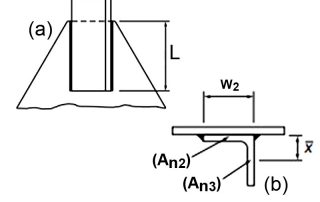
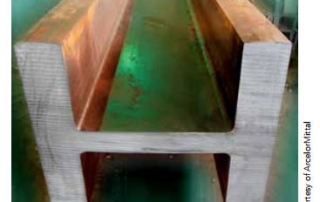
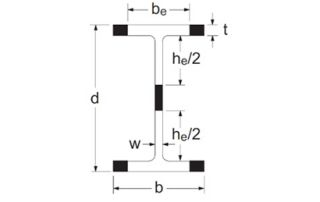
Torsional section properties found in the Handbook include the St. Venant constant (J) and the warping constant (Cw). General formulas do not usually incorporate the contributions of the round fillets at the intersection of the web and flange(s) in open sections, as shown in Figure 1. The fillets are not taken into account for angle sections, [...]

2017-09-11T11:22:02-04:00July 22nd, 2016|Tags: |

Class 4 Sections in Axial Compression

Two methods are provided in CSA Standard S16-14, to determine the factored compressive resistance, Cr, for sections that exceed the width (or diameter)-to-thickness ratios specified in Table 1 of the S16-14. These are the effective area method and the effective yield stress method.   Effective Area Method   Engineers are generally familiar with the concept of [...]

2017-04-03T12:27:41-04:00June 21st, 2016|Tags: |

Historical Structural Steels

Engineers are often faced with the challenge of determining the yield strength or tensile strength of structural steel members found in historical steel buildings. This becomes particularly important for rehabilitation and renovation works. The table below is an excerpt taken from Part Six of the CISC Handbook of Steel Construction. Note that the yield strength and [...]

2017-04-03T12:27:31-04:00June 21st, 2016|Tags: |

Increase in Probable Strength of HSS Braces

Advantages of HSS as braces The popularity of hollow structural section bracing stems from two facts: a) Square and circular HSS do not have a minor axis Typically, the compressive resistance, Cr, for a brace is considerably smaller than its tensile resistance, Tr (for CSA G40.21 350W steel, Cr for a brace at the maximum permissible [...]

2017-04-21T14:38:10-04:00June 1st, 2016|Tags: , |

Bracing Design and Initial Misalignment

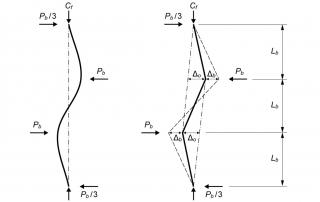
The bracing force, Pb, required to stabilize a laterally unsupported member is a function of several factors including the initial out-of-straightness or misalignment at the brace point, ΔO, and the displacement of the bracing system, Δb, according to S16-14 Clause 9.2.6.2:

2017-04-03T12:26:47-04:00May 27th, 2016|Tags: |

A Useful Engineering Tool to Quickly Calculate the Compressive Resistance of Compression Members

One of the many hidden gems within the CISC’s Handbook of Steel Construction is the Unit Factored Compressive Resistances, Cr/A tables in Part 4. These tables provide a quick and easy method of calculating the compressive resistances of compression members, such as columns or struts. Essentially, the tables list the unit factored compressive resistance, Cr/A (in [...]

2017-04-03T12:26:50-04:00May 18th, 2016|Tags: , |

Designing Multi-Orientation Fillet Welds

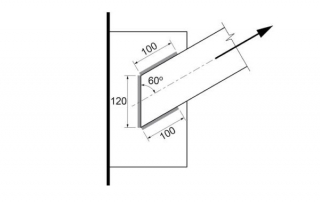
Here is an example on how to apply the strength reduction factor, Mw for multi-orientation fillet welds. In the weld configuration shown in Figure 1, 8-millimetre fillet welds are used, Xu = 490 MPa and the plate is G40.21 350W steel. Note that the farside plate is thicker. In accordance with CSA S16-14 Clause 13.13.2.2:                Vr = [...]

2017-04-03T12:26:56-04:00May 6th, 2016|Tags: , |

Ductile Moment Connections

The discussion herein concerns ductile moment connections only and therefore does not apply to connections used in moment-resisting frames in ‘conventional construction’. Following the Northridge earthquake in 1994, North American standards mandated physical testing as the basis for design of beam-to-column connections in ductile steel moment-resisting frames. This requirement was adopted as an interim measure until [...]

2017-04-03T12:27:00-04:00April 29th, 2016|Tags: , |
Go to Top